
How Do You Find a Good Concrete Patio Contractor?

You have been picturing it for a while now: a clean, well-finished patio where the family actually wants to spend time, with enough space for a grill, a few chairs, and a fire pit on cool fall evenings. You have done some browsing, maybe saved a few photos, and now you are at the point where you need to find someone you can actually trust to pour it. That is where things get harder than most homeowners expect.
The difference between a patio that looks great for twenty years and one that cracks and settles within three often comes down entirely to who you hire. This post walks you through how to find a skilled, dependable contractor in the Pittsburgh area, what questions to ask before signing anything, and what red flags to watch for when comparing bids. If you are already thinking about what a finished Patios project could look like, that link is worth a visit while you plan.

What Actually Separates a Good Contractor from an Average One
The most important quality a contractor can have is not a low price or a fast timeline. It is the ability to do the technical groundwork correctly before a single yard of concrete is ever poured. Proper subgrade preparation, appropriate mix design, and correctly placed control joints are the decisions that determine how long your patio holds up, and most homeowners never see any of it happen.
A reliable contractor will also carry both general liability insurance and workers' compensation coverage, and they will not hesitate to provide proof. They will pull permits where required, document the scope of work in a written contract, and give you a realistic project timeline rather than a vague promise. These are not extras. They are the baseline you should expect from anyone you allow to do permanent work on your property.
Experienced contractors also know how to read a site. Drainage, slope, and the condition of the existing ground all influence how the slab will perform over time. A contractor who skips a site walk or hands you a quote over the phone without looking at the area is not someone you want managing a permanent outdoor installation.
Why the Cheapest Bid Is Usually the Most Expensive Decision
When three bids land in your inbox and one is noticeably lower than the others, it feels tempting. Here is what that number usually means in practice: thinner concrete, less base material, no reinforcement, or a crew that moves fast and skips steps. The work looks identical on the surface when it is finished. The difference shows up two winters later when cracks appear or the slab begins to heave.
Concrete work is not a product you can return or easily redo. Once it cures, it is there. A contractor who cuts corners on the pour is rarely someone who stands behind their work when problems surface after the job is done. Comparing bids thoughtfully means looking at what is included in each proposal, not just the number at the bottom. Ask how thick the slab will be, what base preparation is included, and what concrete mix will be used for the finished surface.
If you want a deeper look at how bid comparisons work in practice, the Stamped Concrete Cost Guide: What to Expect for Your Project is a useful reference for understanding what line items should appear in a well-structured proposal.
Site-Specific Challenges in Pittsburgh, PA
Western Pennsylvania has specific site conditions that make concrete work more demanding than it is in many other parts of the country. The clay-heavy subgrade common across Allegheny County and Washington County is notorious for shifting when moisture content changes. Without proper compaction and a well-prepared gravel base underneath the slab, that clay will move with the seasons and take your patio with it. A contractor who skips base prep to save time is setting up a failure that will show up within a few years.
Pittsburgh winters also bring dozens of freeze-thaw cycles between November and March. Water that gets into a poorly finished slab expands when it freezes, and that repeated expansion breaks concrete from the inside out. Air-entrained concrete mixes and properly spaced control joints are what give slabs the flexibility to handle that stress without cracking. If a contractor in McMurray or Finleyville cannot tell you specifically how they address freeze-thaw performance, that is a problem worth taking seriously.
When you are searching for concrete patio contractors near me, filtering results by local experience matters more in Pittsburgh than in most markets precisely because of these regional conditions. A contractor who works regularly in Western PA will already know what the ground does and how to build for it.
Installation Quality: What the Hiring Process Should Look Like
Start with a short list of local contractors who have a real presence in the Pittsburgh area: a website with project photos, verifiable reviews, and a physical service area that includes your community. Request a site visit from any contractor you are seriously considering. A good contractor wants to see the ground, check for drainage issues, and understand what you are trying to build before quoting a number.
After site visits, compare written proposals carefully. Cost varies based on square footage, site conditions, finish type, and the complexity of the design. Stamped concrete and decorative finishes add an artistic dimension to the project, and if you are thinking about expanding the project to include a Pool Decks surface or a new Driveways approach, that should be part of the conversation from the start. Because every site and every project is different, the most accurate way to understand what your patio will cost is to get an on-site quote from a contractor who has actually walked the space.
Homeowners who have searched for concrete patio contractors near me often find that narrowing results to contractors with demonstrated local portfolios saves a great deal of time and avoids a lot of the risk that comes with hiring a generalist who has never worked with Pittsburgh-area soil conditions.
Bid Comparison Fundamentals: The Questions Worth Asking Before You Sign
Before committing to any contractor, ask for references from recent patio projects in your area and follow through on actually calling them. Ask how long the contractor has been doing concrete work in the Pittsburgh region, whether they use subcontractors, and who will be on-site managing the pour. The answers tell you a great deal about how the project will actually run.
Also ask about the warranty. A confident contractor stands behind their work and will tell you exactly what they cover and for how long. If you want to do more reading before making your decision, the post on How to Find Quality Concrete Contractors Near You covers complementary ground that is worth your time. And if your project includes surfaces beyond a standard patio, such as Concrete Countertops for an outdoor kitchen setup, bring that up early so the contractor can scope the full project from day one.
Anyone still in the early research phase who is comparing material options may also find Concrete Driveway vs Other Materials: Pros and Cons useful for understanding why poured concrete consistently outperforms alternatives in climates like Pittsburgh's.
FAQ
How do I find concrete patio contractors near me that I can actually trust?
Start by looking for contractors with documented work in your specific area, verified reviews on Google or Houzz, and photos of completed projects similar to yours. Ask for references and call them. A trustworthy contractor will carry current insurance, provide a written contract, and walk your site before giving you a quote. Searching for concrete patio contractors near me and then filtering by local reviews and portfolios is the most reliable starting point.
Is a concrete patio worth the investment compared to pavers or composite decking?
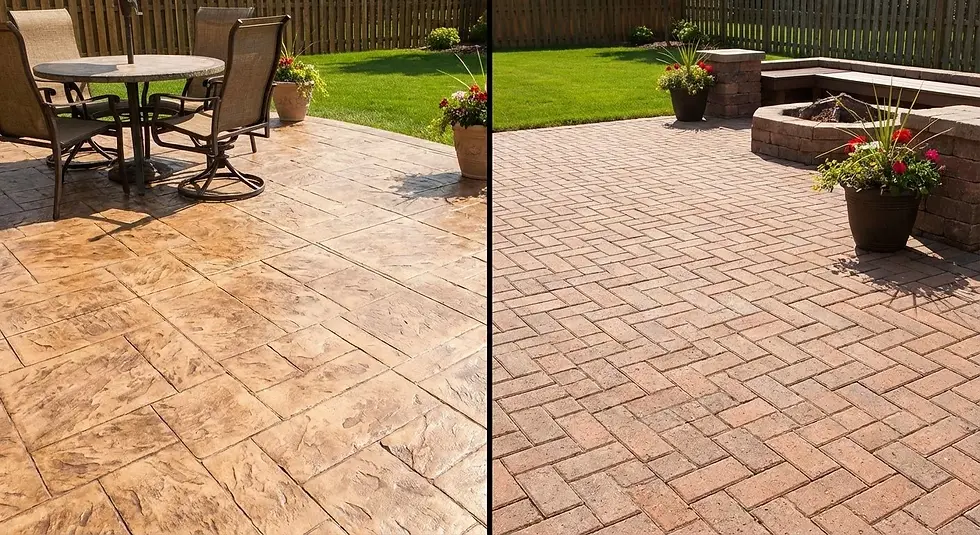
Concrete is one of the most durable and lowest-maintenance patio surfaces available, and when finished with stamped or decorative techniques it is also one of the most visually striking. Unlike pavers, it does not shift or develop weeds between joints over time. For homeowners who want a surface that holds its shape and appearance for decades, poured concrete consistently delivers strong long-term value.
How long does it take to install a concrete patio?
Most residential concrete patio installations take one to three days for the pour itself, depending on size and complexity. Concrete typically needs to cure for at least a week before light foot traffic, and you should wait longer before placing furniture or heavy items. Your contractor should give you a specific timeline based on the scope of your project and current weather conditions.
Do I need a permit for a concrete patio in Allegheny County or Washington County?
Permit requirements vary by municipality across the Pittsburgh region. Some townships require permits for any permanent concrete structure, while others have thresholds based on size or proximity to property lines. A reputable local contractor will know the requirements for your specific community and handle the permit process as part of the job. For more on how permits work for outdoor concrete projects, the post on What Building Permits Are Required for New Driveways? provides a useful overview of the process.
What finish options are available for a concrete patio?
Poured concrete patios can be finished in a wide range of styles, including brushed, exposed aggregate, colored, and stamped patterns that replicate the look of stone, slate, or brick. Stamped concrete in particular has become a popular choice for Pittsburgh-area homeowners who want the look of natural materials with the durability and low maintenance of concrete. You can explore design options in more detail in the post on Popular Stamped Concrete Patterns and Design Ideas.
How does Pittsburgh's climate affect concrete patio performance?
The freeze-thaw cycles that Pittsburgh experiences between November and March put significant stress on outdoor concrete. Slabs that were not poured with air-entrained mixes or that lack properly spaced control joints are especially vulnerable to cracking and heaving over time. A contractor with real local experience will build for these conditions from the start rather than treat them as an afterthought.
How do I get started with BRK Custom Concrete?
Getting started is straightforward. Contact BRK Custom Concrete to schedule an on-site consultation, during which the team will assess your space, discuss your goals, and provide an accurate quote based on your specific site conditions and project scope. BRK serves homeowners across Pittsburgh, McMurray, Finleyville, and the surrounding Western PA communities.
BRK Custom Concrete: Pittsburgh's Trusted Choice for Outdoor Concrete
With years of experience serving Pittsburgh-area homeowners across Allegheny and Washington Counties, BRK Custom Concrete brings the kind of craftsmanship and local knowledge that makes a real difference in how your project turns out. The team understands the specific soil conditions and seasonal demands that Western Pennsylvania throws at outdoor concrete, and every project is built to handle them. From a simple backyard patio to a complete outdoor living space that includes Retaining Walls or Sidewalks, the work is done right the first time.
If you are ready to move forward or you just want an honest conversation about what your project would involve, now is a good time to reach out. Spring and summer calendars fill up quickly for concrete contractors throughout the Pittsburgh region, and getting on the schedule early gives you the best shot at your preferred start date. Visit BRK Custom Concrete or call 412-419-8123 today. Every project starts with a free on-site consultation so you know exactly what you are getting before any work begins. Contact us for more information.



Comments