
Stamped Concrete vs Pavers: Which Is the Better Choice for Your Patio?

You have been staring at your backyard for two summers now, imagining what it could become. Maybe you want a wide, welcoming patio where the family gathers after dinner, or a refined outdoor space that finally matches the home you have been putting work into. You have narrowed it down to two options: stamped concrete or pavers. Both look great in photos, and your neighbor seems happy with whichever one they chose. Now you need to figure out which one actually makes sense for your yard, your budget, and your life.
The choice between stamped concrete and pavers is not just about aesthetics. It involves long-term maintenance, performance in real weather, installation costs, and what each surface will look and feel like a decade from now. This post walks you through every factor that genuinely moves the needle so you can make a confident decision. If you are already thinking about transforming your outdoor space, start by exploring your options on the Patios page. Keep reading, because the details here could save you from a decision you regret.
Why Pittsburgh Conditions Change the Calculation
Pittsburgh homeowners face a set of conditions that most online comparisons simply ignore. Western PA winters put outdoor surfaces through a serious stress test. Freeze-thaw cycles, road salt tracked onto patios, and the kind of ground movement that comes with real seasonal temperature swings can expose weaknesses in any installation that was not designed for this climate. Understanding how stamped concrete and pavers compare in cost for Pittsburgh homes is not just about comparing price tags. It is about understanding what each investment is actually worth over time in a region where the wrong choice cracks, shifts, or fades within a few years.
Here in the Pittsburgh area, including communities like McMurray and Finleyville, concrete patios have a long track record precisely because they can be engineered to handle local conditions. When properly mixed with air-entrained concrete and cut with control joints at the right intervals, a stamped concrete patio manages the expansion and contraction of freeze-thaw cycles without compromising the surface. Pavers have their own advantages, but they rely on a stable base and solid joint sand to stay in place, and both can be compromised by ground heave over time.
The Real Trade-Offs Between These Two Patio Materials
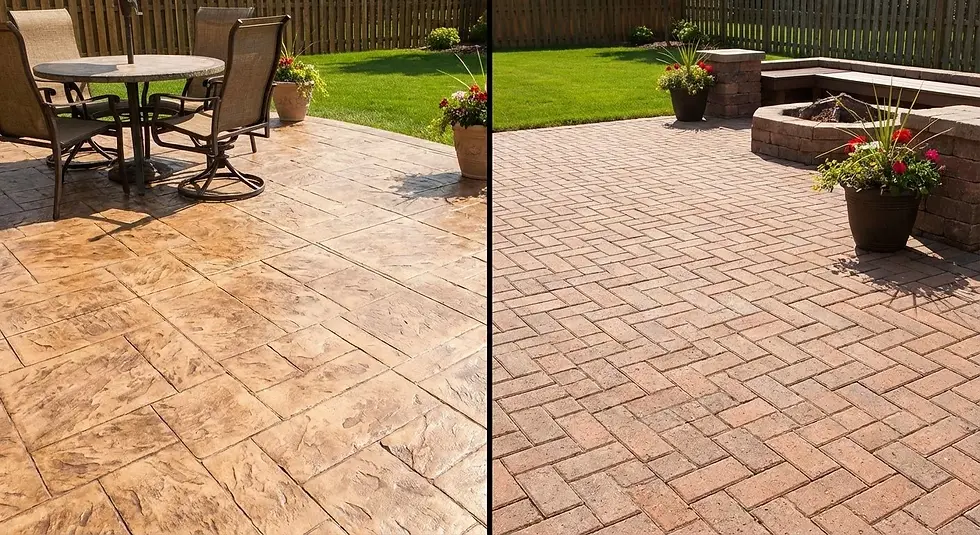
On the surface, both materials can look equally stunning. Stamped concrete mimics slate, flagstone, brick, cobblestone, and dozens of other textures and patterns. Pavers offer a modular, individually placed look with natural variation built in. The visual gap between the two has narrowed considerably as stamping techniques and color systems have improved. The differences that actually matter to a homeowner five years in are durability, maintenance requirements, and how each surface responds to the specific stresses your yard puts on it.
Stamped concrete is a single poured slab. That means fewer joints for weeds to grow through, no individual pieces to shift or sink, and a surface that is fast and straightforward to seal and maintain. The tradeoff is that if a section does crack, repairs are visible because matching color and texture in a patch is difficult. Pavers, on the other hand, can be lifted and replaced individually, which makes spot repairs less obvious. However, individual pavers can settle unevenly over time, and the joints between them are a continuous maintenance responsibility that many homeowners underestimate.
Road salt is another honest consideration for anyone in the Pittsburgh area. Salt tracked in from driveways or used around adjacent concrete areas can cause surface scaling on both materials if they were not installed correctly. For stamped concrete, this means sealing on a regular schedule is not optional. A properly sealed and maintained surface can look great for twenty years, while one that goes without attention may start showing wear in five.
Durability Comparison: Which Surface Holds Up Longer
The single biggest variable in how either surface performs is not the material itself. It is the quality of the installation. A well-prepared base, properly compacted and leveled, is what keeps both pavers and stamped concrete from developing drainage problems and surface failures over time. This is where working with an experienced concrete contractor in Pittsburgh, PA makes a measurable difference in the result you live with.
For stamped concrete, the timing of the stamping process matters enormously. It has to happen in a precise window as the concrete cures. Too early and the pattern blurs. Too late and the stamps do not press cleanly into the surface. The coloring process, whether integral or broadcast, needs to be applied consistently to avoid blotchy or faded results. These are skills that come from experience, not theory, and they are why the contractor you choose matters as much as the material you pick. You can see examples of finished projects in the Gallery to get a sense of what quality installation looks like.
Climate Considerations: How Freeze-Thaw Cycles Affect Each Option
Western PA can see dozens of freeze-thaw cycles in a single winter. Water that gets into small voids in the surface expands as it freezes and creates pressure that breaks material apart from within. For concrete, air-entrainment in the mix creates microscopic bubbles that give expanding water somewhere to go, reducing the risk of surface scaling and spalling. Control joints give the slab a place to move predictably rather than cracking randomly.
For pavers, the concern is base erosion and joint sand washout. If either degrades, individual pieces shift and create uneven surfaces that become both a tripping hazard and a drainage problem. Proper installation with a deep, compacted base and polymeric joint sand dramatically reduces this risk, but it adds to the upfront cost and demands skilled installation.
Installation and Maintenance: What Each Surface Actually Requires
Stamped concrete should be sealed when it is first installed and then resealed every few years depending on traffic and exposure. This is not a difficult process, but it is a recurring one. The sealer protects the color, enhances the pattern, and creates a barrier against moisture and salt. Skipping it shortens the life of the surface noticeably. For a deeper look at what these projects typically involve from start to finish, the Complete Guide to Concrete Driveway Installation Process covers installation fundamentals that apply to patios as well.
Pavers need joint sand refreshed periodically, and depending on the setting, individual pieces may need releveling. Moss and weeds can colonize joints over time, especially in shaded areas. Both surfaces require attention to stay in top condition, but the nature of that attention is different. Stamped concrete maintenance is periodic and surface-level. Paver maintenance can be more labor-intensive when settling occurs.
Cost Breakdown: Pricing Out Stamped Concrete vs Pavers
Breaking down the price difference between stamped concrete and pavers requires looking beyond materials alone. The size of the patio, the complexity of the pattern, the preparation required for the base, and the accessibility of the site all drive costs in either direction. Stamped concrete tends to have lower upfront material costs but requires professional installation to get right. Pavers can carry higher material costs depending on the type selected, and installation labor for a quality base-prep and setting job is significant.
The relevant question is not just which costs less today but which delivers the most value for your specific situation over the next ten to twenty years. Given the climate in Washington County and Allegheny County, factoring in long-term sealing and maintenance costs is important to getting an honest comparison. For a detailed look at what stamped concrete projects typically run in this area, the Stamped Concrete Cost Guide: What to Expect for Your Project is a useful starting point. BRK Custom Concrete can walk you through what a project like yours would realistically involve. Contact us for an accurate quote based on your actual site and goals.
What Makes the Difference Between a Surface That Lasts and One That Does Not
Neither stamped concrete nor pavers will perform well if the installation cuts corners on base preparation, mix quality, or finishing technique. Both materials have decades of proven performance in climates like Pittsburgh's, but both can fail quickly when installed by someone who does not understand the local demands.
If you have a pool or are considering adding one, understanding how these materials perform around water changes the equation further. The Pool Decks page has more on surfaces built specifically for that environment. If your project also includes a driveway, the Driveways page covers material options and what to expect from a quality installation in this region.
BRK Custom Concrete has served Pittsburgh homeowners and the surrounding Western PA communities for years, helping hundreds of families turn underused backyard space into something they actually use and enjoy every season. The team understands what works in this climate, how to prepare a base that holds up through real winters, and how to deliver stamped concrete results that look custom because they are.
FAQ
How does stamped concrete vs pavers cost break down for a typical patio?
Costs for both options vary based on patio size, pattern complexity, base preparation needs, and local labor rates. Stamped concrete generally has lower material costs, while high-end pavers can carry a premium price. The best way to compare accurately is to get a quote for both from a local contractor who can assess your specific site.
Is stamped concrete durable enough for Pittsburgh winters?
Yes, when installed correctly with an air-entrained concrete mix and properly spaced control joints, stamped concrete handles Western PA freeze-thaw cycles reliably. Sealing the surface on a regular schedule adds additional protection against moisture intrusion and salt exposure, which are common stressors in this region.
How long does it take to install a stamped concrete patio?
Most residential stamped concrete patios take one to three days to pour and stamp, depending on size and pattern complexity. The concrete then needs several days to cure before it can handle foot traffic, and full strength develops over about a month. Weather conditions in Pittsburgh can affect scheduling, so plan for some flexibility.
Do pavers or stamped concrete hold up better around a pool?
Both can work well around a pool when installed correctly, but the specific surface texture, slip resistance, and drainage slope matter more in wet environments than the material type alone. A contractor experienced with Pool Decks will know which finishes and configurations perform best for poolside conditions.
Can stamped concrete be repaired if it cracks?
Yes, cracks in stamped concrete can be repaired, but matching the color and pattern exactly is difficult. This is why proper installation with control joints is so important. A crack that forms at a planned joint is far less visible and disruptive than one that runs through the middle of a stamped pattern without a planned seam.
How long does stamped concrete last compared to pavers in a cold climate?
Both materials can last twenty years or more when installed correctly and maintained on a consistent schedule. Stamped concrete longevity in cold climates depends heavily on the concrete mix and sealing frequency. Pavers depend on base stability and joint sand condition. The How Long Does Stamped Concrete Last in Cold Climates? post covers this topic in more detail for Pittsburgh-area homeowners.
How do I get started with BRK Custom Concrete for a patio project?
Reach out for a free consultation and the team will assess your site, discuss your design goals, and walk you through your options for stamped concrete or pavers. BRK Custom Concrete serves Pittsburgh, McMurray, Finleyville, and communities throughout Washington County and Allegheny County. Getting a personalized quote takes the guesswork out of comparing costs and timelines.
Ready to Build the Patio You Have Been Picturing?
With years of experience serving Pittsburgh homeowners and the surrounding Western PA communities, our team has helped hundreds of families turn underused backyard space into something they actually use and enjoy every season. We know what works in this climate, how to prepare a base that holds up through real winters, and how to deliver stamped concrete results that look custom because they are. Whether you are drawn to the seamless finish of stamped concrete or the classic look of pavers, we will help you make the right call for your home and your budget.
BRK Custom Concrete is a trusted concrete contractor based in Finleyville, serving Pittsburgh, McMurray, and communities across Washington County and Allegheny County. If you are ready to stop imagining and start building, now is the time to take the next step toward a patio that adds real value and enjoyment to your home.
Visit BRK Custom Concrete or call 412-419-8123 today. Get expert guidance on the right surface for your patio from a team that knows Western PA conditions inside and out. Contact us for more information.


Comments