
Is Concrete or Pavers Better for Your Pool Deck?

You finally have the pool in the ground, the kids are counting down the days, and now you are standing in your backyard staring at raw dirt and wondering what goes around the water. The deck material you choose will shape how your outdoor space looks, how much maintenance it demands, and how well it survives a Pittsburgh winter five years from now. This is not a small decision, and the showroom photos do not always tell the full story.
The tension between a concrete pool deck and pavers is real, and it trips up homeowners across the Pittsburgh area every season. Both materials have genuine strengths, but the right answer depends on your yard, your budget, your tolerance for upkeep, and how Western PA weather treats outdoor surfaces over time. This post breaks down every factor that matters so you can move forward with confidence. If you are also weighing options for other hardscaping projects around your home, our Pool Decks service page is a solid place to start.

Why This Matters for Pittsburgh, PA Residents
Choosing between a concrete pool deck and pavers is not just a style debate in Pittsburgh. It is a practical engineering question shaped by a climate that delivers dozens of freeze-thaw cycles every winter. Water seeps into any small gap, freezes, expands, and repeats that process all season long. Concrete mixed and installed correctly, with the right air-entrained formula and properly placed control joints, handles that stress far better than a rushed job with a standard mix. Understanding this local reality is step one before you compare any surface on aesthetics alone.
Homeowners in McMurray and across Washington County also deal with road salt and deicing chemicals that creep onto pool decks from driveways and footwear. That chemical exposure causes surface scaling on concrete that is improperly sealed or mixed, which is why the right mix design and a consistent sealing schedule matter more here than in warmer, milder regions. When you hire a concrete contractor in Pittsburgh, PA, make sure they understand these local realities before you evaluate estimates.
The Real Trade-Off Between Concrete and Pavers
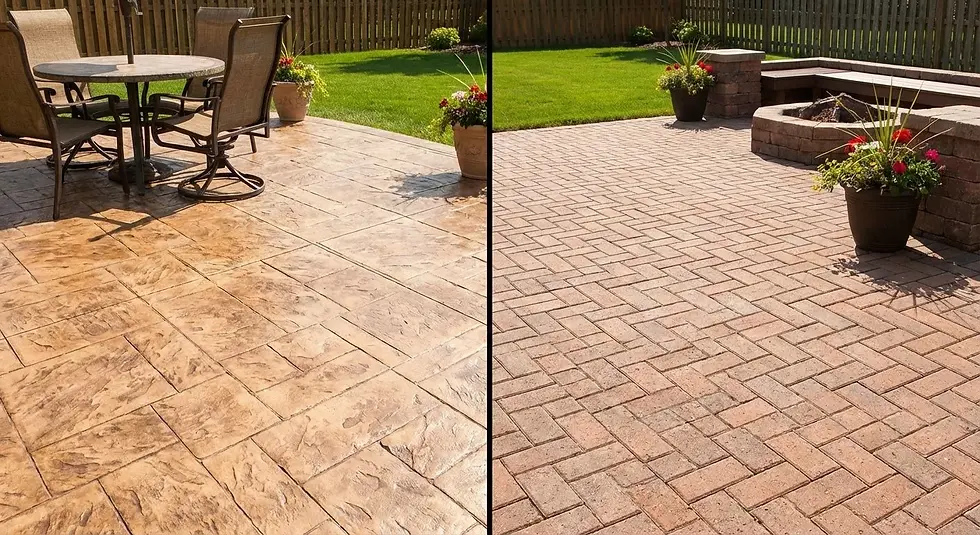
Concrete and pavers each deliver a beautiful finished surface, but the way they get there, and what happens afterward, differs in ways that compound over years of use. Poured concrete gives you a continuous, seamless surface that can be stamped, stained, brushed, or polished into almost any look. Pavers give you individual units with joints between them, which means the visual appeal is inherently textured and modular. Neither is objectively better. The better choice is the one that fits how you live outdoors.
The argument homeowners hear most often in favor of pavers is that individual units can be lifted and replaced if one cracks or shifts. That is true, but it comes with a hidden cost: the joints between pavers collect algae, weeds, and debris, and they require regular maintenance to stay clean and stable. Around a pool, where water, chemicals, and bare feet are constant, that maintenance gap matters. Concrete, by contrast, has no joints for weeds to invade and can be power-washed and resealed in a single afternoon.
Stamped concrete closes the aesthetic gap that once made pavers the obvious choice for homeowners who wanted a high-end look. A skilled installer can replicate the appearance of natural stone, brick, or slate with textured concrete, giving you the visual appeal of pavers with the structural advantages of a poured slab. If you want to explore design possibilities in more depth, our post on Popular Stamped Concrete Patterns and Design Ideas covers a wide range of options worth considering alongside this comparison.
Durability, Slip Resistance, and Long-Term Performance
Durability around a pool means more than just surviving the weather. It means holding up under foot traffic, UV exposure, pool chemicals, and the constant wet-dry cycle that surrounds any body of water. Concrete installed with the proper thickness, reinforcement, and mix design is a highly durable surface that performs reliably for decades when it is built right and maintained on schedule.
Pavers are durable as individual units, but the system as a whole is only as stable as the compacted base beneath it. If that base shifts or settles unevenly, pavers rock, trip people, and create drainage problems. In yards with heavier clay soil or significant grade changes, which describes much of the Pittsburgh region, maintaining a perfectly stable paver base over time is an ongoing challenge rather than a one-time installation.
Traction and Pool Safety
Slip resistance is non-negotiable around water, and concrete gives you more control over it than pavers do. A brushed or broom-finished concrete surface provides consistent traction across the entire deck. Exposed aggregate finishes take that a step further, embedding small stones into the surface for grip that does not wear smooth the way a polished paver can.
Pavers offer natural texture, but the surface between joints can become slippery when algae builds up in damp shaded areas. Regular cleaning keeps that risk manageable, but it is a maintenance responsibility that concrete handled with the right finish largely avoids.
Drainage and Water Management
Concrete pool decks are typically poured with a slight slope away from the pool edge to direct water toward the surrounding landscape or a drain system. That slope is engineered into the slab during installation and stays consistent for the life of the surface. Pavers rely on permeable joints to let water drain through, which works well when the joints are clean and the base is properly graded. Over time, debris fills those joints and drainage performance can drop.
What Pool Deck Installation Actually Costs in Western PA
Pricing for a pool deck depends on square footage, surface finish, site conditions, and the complexity of any curves or steps involved. A basic broom-finished concrete deck will come in at a different price point than a full stamped and stained design with decorative borders. Pavers carry their own cost variables including material selection, base preparation depth, and labor for the pattern layout and cutting around pool edges.
The good news is that concrete typically requires less long-term maintenance spending than pavers, which can offset any upfront difference over the life of the deck. There is no single number that fits every backyard, and any contractor who quotes a price without seeing your specific site is working from guesswork. Our Stamped Concrete Cost Guide: What to Expect for Your Project offers useful context on how finishes affect overall project pricing. Reach out to BRK Custom Concrete for a proper on-site assessment and an accurate quote built around your actual conditions.
What Separates a Great Installation from an Average One
The single biggest factor in how any pool deck performs over time is not the material itself. It is the quality of the installation. Concrete poured over an unprepared subbase, without proper reinforcement or control joints, will crack regardless of how good the mix is. Pavers laid over a poorly compacted base will shift no matter how premium the individual stones are.
For concrete specifically in the Pittsburgh area, ask any contractor you are evaluating how they handle cold-weather pours, what admixtures they use for freeze-thaw resistance, and what their sealing recommendation is for the first year. Those answers tell you quickly whether you are talking to someone who understands Western PA conditions or someone repeating a script. Our guide on How to Find Quality Concrete Contractors Near You walks through exactly what to look for when vetting local professionals.
FAQ
How long does a concrete pool deck last compared to pavers?
A properly installed concrete pool deck can last 25 to 30 years or more with routine sealing and minor crack repair. Pavers as individual units are durable, but the overall surface can shift or settle within 10 to 15 years if the base deteriorates. Concrete tends to deliver more predictable long-term performance in climates with heavy freeze-thaw cycles like Pittsburgh's.
Is stamped concrete slippery around a pool?
Stamped concrete can be slippery when wet if it is finished with a smooth texture and a high-gloss sealer. A quality installer will add a non-slip aggregate or anti-skid additive to the sealer coat to maintain traction around the water's edge. Ask your contractor specifically about slip resistance before any finish decision is finalized.
How much does pool deck installation cost in Pittsburgh?
Pool deck costs vary based on surface area, finish type, site preparation requirements, and design complexity. There is no single figure that applies to every project. The most reliable way to understand what your specific deck will cost is to contact a local contractor for an on-site evaluation and written estimate.
Do I need to seal a concrete pool deck in Western PA?
Yes, sealing is an important part of maintaining a concrete pool deck in Western PA. The combination of pool chemicals, UV exposure, and freeze-thaw cycles creates ongoing stress on the surface, and a quality sealer applied on the right schedule protects the concrete from scaling and surface wear. Most installers recommend resealing every two to three years depending on traffic and exposure.
Can pavers be installed over an existing concrete pool deck?
Yes, pavers can be installed over an existing concrete slab in some cases, but it depends on the condition of the existing concrete and the height constraints around the pool coping and drainage. This approach is sometimes used to refresh an older surface without full demolition, though a proper evaluation of the existing slab is required before any work begins.
How does Pittsburgh's climate affect which pool deck material I should choose?
Pittsburgh's freeze-thaw cycles put real stress on any outdoor surface. Concrete installed with air-entrained mix designs and proper control joints is specifically engineered to handle that movement. Paver systems depend heavily on a stable compacted base, which can be difficult to maintain in clay-heavy soils common throughout Allegheny and Washington Counties. For most Pittsburgh-area homeowners, a properly installed concrete deck offers more reliable long-term performance given local conditions.
How do I get started with BRK Custom Concrete for a pool deck?
Getting started is straightforward. Contact BRK Custom Concrete to schedule an on-site visit where a member of our team assesses your space, discusses your design goals, and provides an accurate quote. We serve homeowners across Pittsburgh, McMurray, Finleyville, and the wider Allegheny and Washington County areas.
Ready to Build a Pool Deck That Lasts in Pittsburgh?
BRK Custom Concrete has spent years helping Pittsburgh-area homeowners build outdoor spaces that hold up through real Western PA winters and look exceptional doing it. We understand the local conditions that separate a concrete surface that performs for decades from one that starts showing problems within a few seasons, and we build every deck with that knowledge built into every step of the process.
Whether you are leaning toward a classic broom finish, a stamped design that mimics natural stone, or you simply want an expert opinion before you decide, our team is ready to walk you through your options. BRK Custom Concrete brings trusted craftsmanship to every project across Pittsburgh, McMurray, Finleyville, and the surrounding communities.
Visit BRK Custom Concrete or call 412-419-8123 today. Our team builds pool decks that stand up to Western PA winters and look great for decades. Contact us for more information.



Comments